What a conversation about heritage language learning helped me understand about myself
They say you have to leave before you can ever come home. I wonder if learning another language gives us a chance to do something like that.
We often talk about the doors language learning opens: people, places, experiences, opportunities. But what about the window it opens into ourselves? Could stepping into another language help us recognize nuances of our own language, culture, and voice that we might never have otherwise developed?
That is exactly what happened during our recent conversation with Maria Carreira on The Multiliterate Mind.
The Unexpected Mirror
Maria is a linguist and educator who co-founded the National Heritage Language Resource Center at UCLA, and is currently the executive director of the American Association of Teachers of Spanish and Portuguese (AATSP). She has spent decades working with learners whose relationship with a language often begins at home, long before they encounter it as a subject in school.
I expected to have a fascinating conversation about heritage language learners, but I did not expect to see so much of myself in her story.
Maria was born in Cuba, spent part of her childhood in Spain, and arrived in the United States at age 11. I am an American-born Southern girl, raised in a monolingual English-speaking home. I didn’t begin studying Spanish until high school.
And yet, as she spoke, I kept thinking: Yes. That. I know that feeling.
The conversation almost became a mirror.
Maria described teachers who respected her Spanish and invited her to share her cultural knowledge. Still, she absorbed a message about what was worth pursuing academically.
“The idea was, you know, in school, study something that will get you somewhere.”
She studied math and computer science while also pursuing French and Italian. Spanish helped her succeed in those languages, but studying Spanish itself didn’t seem like something she should do.
I’ve noticed several of our guests began in math or another field before finding their way toward language. Surprise, surprise—another pattern I want to explore! What makes certain kinds of knowledge feel valuable? And when do we recognize the value of what we already carry?
Maria’s Spanish supported her learning of French and Italian. My connection worked in another direction: studying Spanish has made me a better speaker, reader, and writer of English. It helped me hear my own language differently.
Around 1991, a colleague asked Maria to develop a course for heritage speakers. She had completed her own training without encountering the term heritage language learner, even though it described her experience.
That work changed her life.
“I met myself,” she told us.
MM Teaser Maria 2.mp4
I keep thinking about those three words. Through learning how to teach these students, she found language for understanding herself. Have any of you experienced something similar?
Maria described identity as the centerpiece of heritage language learning. Learners may not consciously recognize it, she explained, but studying their home language can be an effort to understand who they are “linguistically, culturally, as human beings.”
Am I American? Am I Cuban? Where do I belong?
She also spoke about confusion, and about learning to tolerate it as part of understanding yourself. That stayed with me. Finding your voice might include becoming more comfortable with questions that don’t have a simple answer.
Then she described something that brought me straight back to my college Spanish classes.
In a classroom with heritage learners and students learning an additional language, each group may feel intimidated by the other. Heritage learners may communicate comfortably but feel lost when classmates begin naming verb tenses. Those classmates may know the terminology yet feel terrified of speaking alongside someone whose Spanish sounds so natural.
I was one of those students. I didn’t want to say a peep.
It had never occurred to me that the classmates who intimidated me might have been experiencing their own insecurity.
How often do we assume that someone else’s confidence extends to everything? How much might we miss when we see a quiet student and think we already know why?
The connection became even clearer when Maria admitted she had written out answers before our interview. She worried about getting something wrong in English.
I whipped out my notes and practically shouted–”Me too!”
Here we were, with different histories and different relationships with English, preparing in much the same way. We both had something to say. We both worried about how we would say it.
This connection led to one of the biggest aha moments of the entire conversation.
“Since we started this podcast, you said that happened to me. You know, things that I tend to associate with heritage language learners. You’re saying, no, you are familiar with this and it has affected you too. So maybe it’s just better to think of, you know, individuals. Yes, exactly. Who learn languages and who speak and communicate maybe just goes back to being human communicators.”
“English and Spanish belong to me,” Maria said.
She described herself as having as much right to speak those languages as anyone else.
Everyone needs to hear that message. How many people are waiting to feel qualified enough to participate? How many of our students have something worth saying today, even as they continue developing the language to say more?
As teachers, we have a responsibility to support that growth. Maria’s questions—what can you do with language, and what do you want to do with it?—connect closely to our work with Proficiency First Multiliteracies. We begin with the learner’s abilities and purposes, then help expand their possibilities.
That includes helping students recognize their own voices.
Art, AI, and Authentic Expression
Our discussion of AI brought this into focus. Maria saw opportunities for practice and preparation, but she also worried about writing that begins to sound the same. How can students judge a tool’s suggestions if they haven’t had opportunities to recognize what makes their expression their own?
MM Teaser Maria.mp4
Then she brought Picasso into the conversation, and my wheels really started turning.
Visiting the Picasso Museum, Maria had noticed how he studied and copied the work of other artists, then brought his own perspective into what he created. She connected that process to writing: learning from others while asking what you can contribute that makes the work yours.
“I have my own voice.”
There are so many connections here. We make meaning through words, images, music, movement, and the ways we combine them. We learn from what others have created. We try things, borrow techniques, and discover choices that express something of ourselves.
Helping students find their voices can mean giving them opportunities to recognize that process across languages and forms of expression. What do I notice? What do I want someone else to understand? How can I make that meaning visible, audible, or felt?
I was so excited by that part of our conversation because it reached into something much bigger than writing.
By the end, Maria was recognizing herself in our experiences, too.
A Chance to Meet Yourself
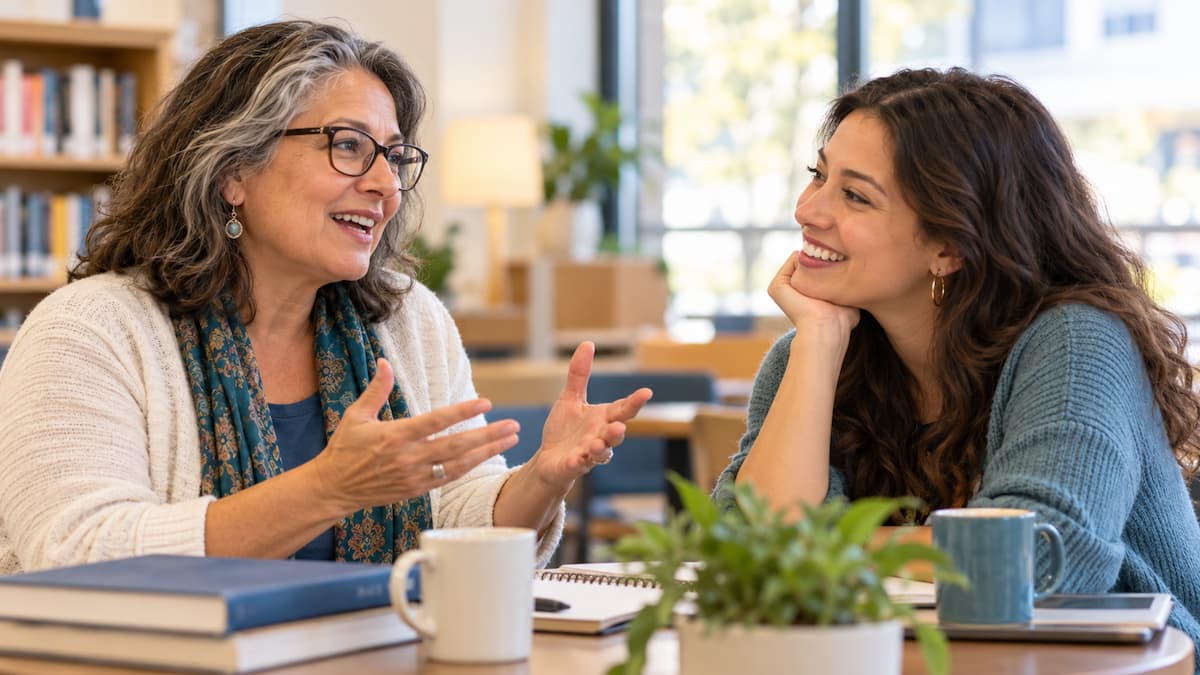
Imagine this: three women with different linguistic and cultural backgrounds, connected by language and the desire to understand how it works, who is speaking it, and why. As we listened to one another, we found new ways to understand ourselves.
I wonder whether conversations like this might be among the most healing things we can offer our students—and our society.
Later in the interview, we talked about listening for understanding. I found myself thinking about how often we miss that opportunity, even in our first language. We are busy preparing our response, worrying about how we sound, or deciding what someone means before they have finished speaking.
What might change if we helped students practice listening with the intention of understanding another person? What might they discover about that person, and about themselves?
I came to this conversation hoping to learn from Maria’s expertise. I left feeling connected to her, and hearing my own experience in a new way.
Maybe that is another reason to learn a language: the chance to meet someone else, and, somewhere in the conversation, meet yourself.
Watch our full conversation with Maria Carreira on The Multiliterate Mind.