
Avant STAMP Overview
Avant STAMPe is a web-based test that assesses language proficiency. It has 4 sections: Lesen, Schreiben, Zuhören and Sprechen.
Each test taker should read through the Leitfaden für Prüfungsteilnehmer.

~30 multiple-choice questions

2 prompts

~30 multiple-choice questions

2 prompts
How the Test Works
Reading and Listening questions are multiple-choice and are scored automatically. The test is computer-adaptive which means it will get easier or harder based on the test taker’s responses.
Writing and Speaking prompts are designed to be cognitively and developmentally appropriate for younger learners. Responses are rated by Avant Certified Raters who use a Scoring Rubric that lists the criteria for meeting Benchmark Levels.
Test Rules
Tests are taken in a proctored environment with no outside resources allowed.

- Klicken Sie nicht außerhalb des Testfensters. Dies wird verfolgt und Sie werden aus dem Test ausgeloggt.

- Verwenden Sie keine Unterstützungsmaterialien (z. B. Wörterbücher, Lehrbücher, Handys, Apps, Messaging-Tools oder Übersetzungshilfen wie Google Translate).

- Notizen machen verboten (auf Papier oder elektronisch). Papier, Stifte, Bleistifte, Eingabestifte usw. sind nicht erlaubt.

- Lesen/benutzen Sie keine Notizen oder Unterstützungsmaterialien für Ihre sprechenden/ausdrucksstarken Antworten.

- Kommunizieren Sie während des Tests mit niemandem außer dem Aufseher.

- Teilen Sie keine Testfragen oder Aufforderungen. Kopieren, drucken oder machen Sie keine Screenshots von dem Test.

- Verwenden Sie keine gewalttätige, unflätige oder unangemessene Sprache in Ihren Antworten.
Preparing for the Test
Avant STAMP is a proficiency test of what the test taker can do with the language at this point in time. There are no “right” or “wrong” answers, simply a demonstration of their skills.
To help each test taker prepare, we do have several resources to help:
Beispieltests
Shows what the test will look like and gives examples of Novice, Intermediate, and Advanced questions and prompts. It does not show the computer-adaptive nature of the test and will not give a score at the end.
Video-Tutorials
Helps the test taker understand how to do their best and what to expect during testing.
Schreibbeispiele
For many languages, we provide real examples of writing responses for each level. Test takers can compare what they know to understand what type of language is expected at each level.
Benchmarks and Rubrics
This guide helps to understand how the test is scored and provides question topics that might be used at each level in the Reading and Listening sections.
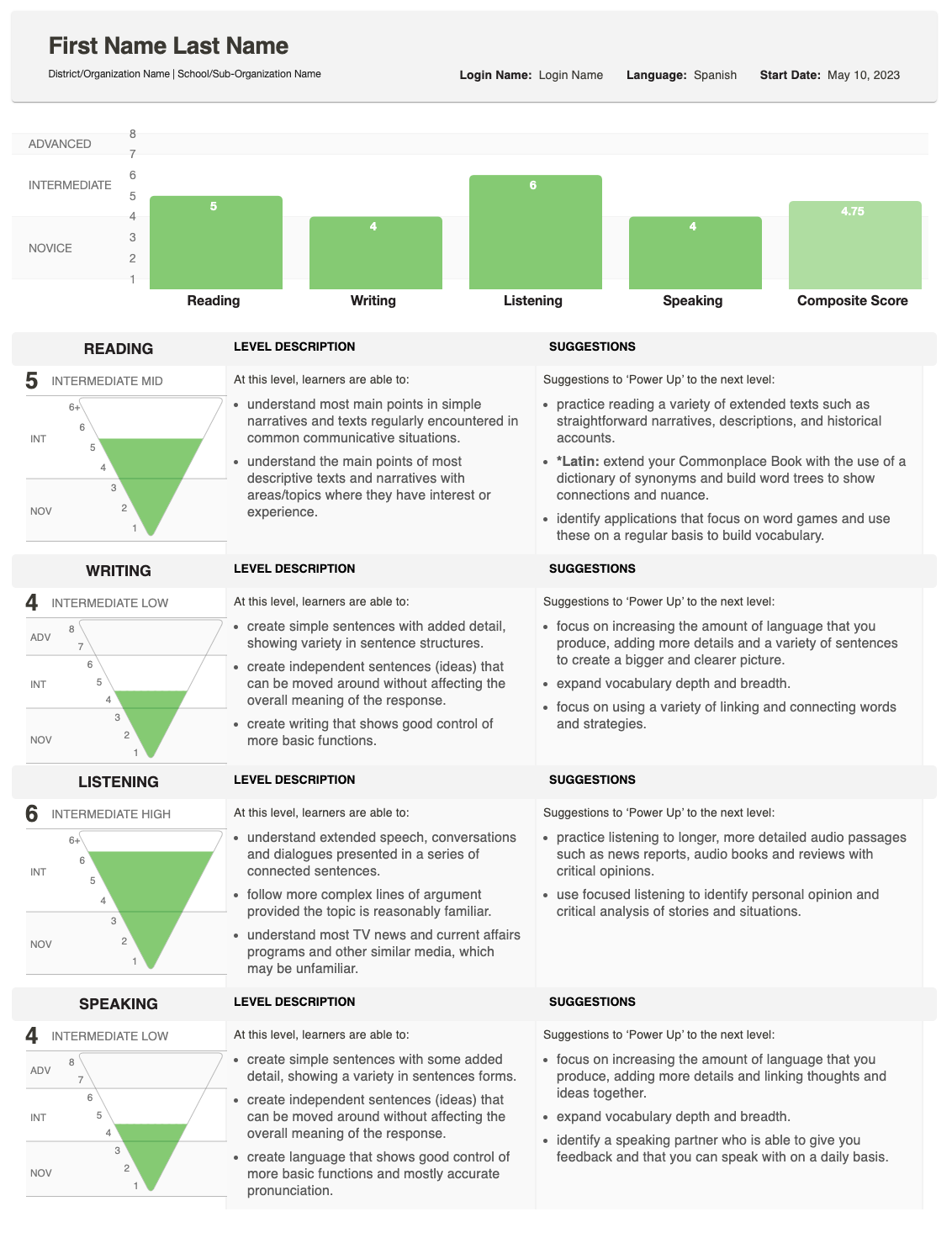
Assessment Results
After scoring is completed, results will be provided to the school or organization administering the test.
The report shows how your student performed in Schreiben and Sprechen and gives an overall (composite) score.
For a detailed explanation of how scores are determined, see the Benchmark and Rubric Guide, which describes what is expected at each level. If you have questions about an individual student’s scores, please contact the school or organization that gave the test.
Understanding the Scores
The Individual Report shows the score earned for each skill, along with a Composite Score.
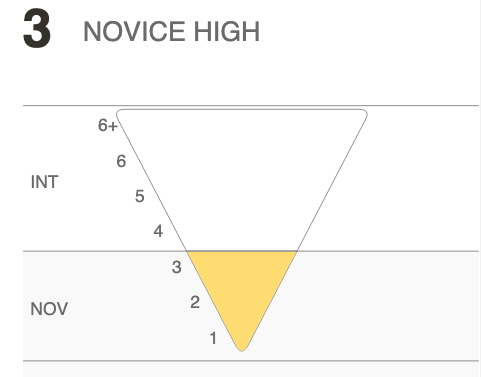
Score Pyramid
An inverted pyramid graphic displays each score. The filled section shows the level reached.
Skill Descriptions
Next to the pyramid, you’ll see descriptions of the skill (Reading, Writing, Listening, Speaking) and the level category (Novice, Intermediate, Advanced).
- If a test section wasn’t finished, this area will instead show the status: Not Started or In Progress.
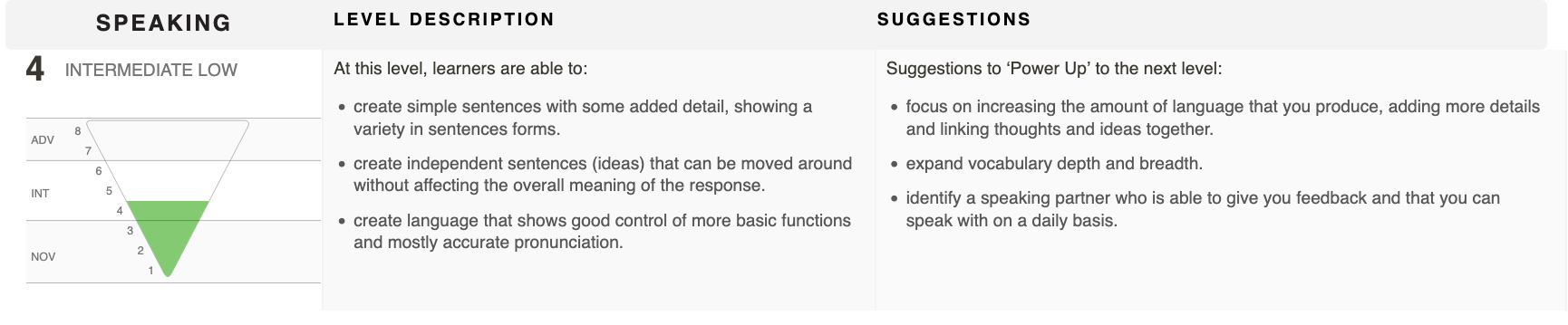
Power Up Suggestions
On the far right, the report lists Power Up Suggestions—practical tips the student can use to improve and reach higher scores in that skill.